I hope the information I've compiled in this blog helps everyone understand my church better. I don't know a lot, but I do know that I appreciate this church and the gospel of Jesus Christ that it teaches. I am also very grateful for the power and authority that God gives to bless all of us.
If anyone reading these blog posts is curious to know more about my church, check out my church's website (lds.org).
Thanks for reading!
Saturday, March 26, 2016

Example of Priesthood Power: Mormon Message "Sanctify Yourselves"
There is a fairly well-known video in the Mormon church that shares an incredible story of priesthood power. This video is a "Mormon Message", a type if video that the Mormon church likes to make and share in order to teach certain principles or beliefs of the church.
The video I'm referring to, called "Sanctify Yourselves", is focused on men being worthy of their priesthood in order to be able to use it to bless the lives of others. Being worthy of the priesthood simply means living a good, Christ-centered life and not committing any major sins.
However, the reason I chose to use this video is not to focus on worthiness, but rather to share the story the video shares of a young man who used his priesthood power.
In the Mormon church, we believe that one of the ways that priesthood power can be used is by healing others. This is done by one or more men who hold the Melchizedek Priesthood putting their hands on the head of the individual to be blessed while one of them gives the blessing. The story in the video gives a great example of the healing power of the priesthood, so I've included the link below.
Sanctify Yourselves
The video I'm referring to, called "Sanctify Yourselves", is focused on men being worthy of their priesthood in order to be able to use it to bless the lives of others. Being worthy of the priesthood simply means living a good, Christ-centered life and not committing any major sins.
However, the reason I chose to use this video is not to focus on worthiness, but rather to share the story the video shares of a young man who used his priesthood power.
In the Mormon church, we believe that one of the ways that priesthood power can be used is by healing others. This is done by one or more men who hold the Melchizedek Priesthood putting their hands on the head of the individual to be blessed while one of them gives the blessing. The story in the video gives a great example of the healing power of the priesthood, so I've included the link below.
Sanctify Yourselves
Example of Priesthood Authority: General Conference
Twice a year, the Church of Jesus Christ of Latter-day Saints has a general conference for all of its members to either attend or view live on television, online, or via satellite. During this general conference, all general leaders of the church are announced, and any changes to any of the general leadership are also announced.
These changes, although brought before the church and sustained (or given approval) by members of the church, are not done by the will of the church. They are done by the will of God, and only those who currently hold the proper priesthood authority may call members of the church to be general leaders (or general authorities as they are commonly called in the church). This process of calling members to certain positions in the church is how the church operates at all levels, even down to the local congregations of the church.
The general conference of The Church of Jesus Christ of Latter-day Saints is a great example of priesthood authority, not only because of the way it shows how members are called to positions of authority, but also because it's a time for all members of the church to listen to leaders of the church give counsel by the priesthood authority that they hold. Below is a link to the last general conference of the church to give an idea of what it's like.
General Conference October 2015
These changes, although brought before the church and sustained (or given approval) by members of the church, are not done by the will of the church. They are done by the will of God, and only those who currently hold the proper priesthood authority may call members of the church to be general leaders (or general authorities as they are commonly called in the church). This process of calling members to certain positions in the church is how the church operates at all levels, even down to the local congregations of the church.
The general conference of The Church of Jesus Christ of Latter-day Saints is a great example of priesthood authority, not only because of the way it shows how members are called to positions of authority, but also because it's a time for all members of the church to listen to leaders of the church give counsel by the priesthood authority that they hold. Below is a link to the last general conference of the church to give an idea of what it's like.
General Conference October 2015
Thursday, March 24, 2016
The Melchizedek Priesthood
The Melchizedek Priesthood was originally called “The Holy Priesthood after the Order of the Son of God”, but it was changed to the Melchizedek Priesthood because:
- Melchizedek was a great man who held this priesthood (“The Holy Priesthood after the Order of the Son of God”)
- Out of respect to Jesus Christ, in an effort to not overuse His name
The Melchizedek Priesthood holds the authority to lead over all of the church
The Melchizedek Priesthood’s focus is on the spiritual needs of others
Doctrine and Covenants (a book of scripture in the Mormon church) Section 107 verses 18-19:
· Verse 18 – “The power and authority of the higher, or Melchizedek Priesthood, is to hold the keys of all the spiritual blessings of the church –“
· Verse 19 – “To have the privilege of receiving the mysteries of the kingdom of heaven, to have the heavens opened unto them, to commune with the general assembly and church of the Firstborn, and to enjoy the communion and presence of God the Father, and Jesus the mediator of the new covenant”
High Priest –
· Have the right to officiate (take charge of, lead, direct) all of the church
· Administer in spiritual things (take care of spiritual needs)
· Also may officiate in all other priesthood offices
Elder –
· Administer in spiritual things (take care of spiritual needs)
· Also may officiate in all other priesthood offices except that of High Priest
The following priesthood offices of the Melchizedek Priesthood are either High Priests or Elders; they are simply given different roles within the church.
Three Presiding High Priests (First Presidency of the Church) –
· President of the Church and his 2 counselors
· President of the Church is the current prophet, like Moses
o Doctrine and Covenants Section 107 verses 91 and 92:
§ Verse 91 – “And again, the duty of the President of the office of the High Priesthood is to preside over the whole church, and to be like unto Moses –“
§ Verse 92 – “Behold, here is wisdom; yea, to be a seer, a revelator, a translator, and a prophet, having all the gifts of God which he bestows upon the head of the church.”
· Basically in charge of everything
· These three are also Apostles, like the members of the Quorum of the Twelve Apostles
· See the following section on the Quorum of the Twelve Apostles
Quorum of the Twelve Apostles –
· Doctrine and Covenants section 107 verse 23:
o “special witnesses of the name of Christ in all the world – thus differing from other officers in the church in the duties of their calling.”
· Doctrine and Covenants section 107 verse 33:
o “officiate in the name of the Lord, under the direction of the Presidency of the Church, agreeable to the institution of heaven”
· Build up the church
· Regulate all the affairs of the church in all nations
· Sent out to open the door to proclamation of the Gospel of Jesus Christ in all the world
· Call members of the quorums of the Seventy
· Ordain patriarchs
o Patriarchs give special blessings to individuals
o These blessings are meant to be guides for this life
· Doctrine and Covenants Section 107 verse 58:
o “to ordain and set in order all the other officers of the church”
Standing High Councils –
· Members of the church called to serve in their areas/stakes
· Doctrine and Covenants section 107 verse 36:
o “form a quorum equal in authority in the affairs of the church, in all their decisions, to the quorum of the presidency, or to the traveling high council.”
· Quorum of the Presidency = The First Presidency
· Traveling High Council = Quorum of the Twelve Apostles
The Seventy –
· Preach the Gospel
· Doctrine and Covenants section 107 verse 25:
o “be especial witnesses unto the Gentiles and in all the world – thus differing from other officers in the church in the duties of their calling.”
o Gentiles are those who are not Jews
· Doctrine and Covenants section 107 verse 38:
o “fill the several calls for preaching and administering the gospel”
· There may be multiple quorums of the Seventy
The Aaronic Priesthood
For this post, I will focus on the roles of the Aaronic Priesthood. I will list the different roles in order of highest authority to lowest authority.
The Aaronic Priesthood is considered a preparatory priesthood. This is because it is a priesthood that helps prepare a man to receive the Melchizedek Priesthood. The Aaronic Priesthood’s focus is on the temporal (earthly, physical, mental, emotional, etc.) needs of others
Bishop –
·
Administer to the temporal needs of members of
his ward (local congregation of members of the church) and in certain cases
others who are not members
·
Be a judge in Israel
o
This refers to when a Bishop meets with members
of the church
§
A Bishop, when meeting with a member of the
church, counsels with him/her, gives advice, helps him/her to repent of sins,
helps him/her to get through trials/tough times, etc.
·
Do the business of the church
o
The Bishop is in charge of the giving aid to
members and non-members alike who ask for financial aid
o
Basically, the Bishop is the leader of the local
ward/congregation
Priest –
·
Preach the Gospel
·
Teach the doctrine/Gospel of Jesus Christ, such
as in a church meeting
o
Expound the doctrine/Gospel of Jesus Christ,
part of teaching. According to the Merriam-Webster
dictionary, to expound means “to explain by setting forth in careful and often
elaborate detail”
·
Exhort others to repent and follow the Gospel of
Jesus Christ
·
Baptize others as members of Christ’s church
·
Administer the sacrament (An ordinance where
members of the church/those who have already been baptized may eat bread and
drink water in order to receive forgiveness for their sins and renew their
covenants. This is instead of being
baptized after every sin.)
·
Visit the house of each member (this is what we call home
teaching). This involves:
o
Exhorting members to pray vocally and in secret
o
Exhorting members to attend to all family duties
·
A priest may ordain other priests, teachers, and
deacons
·
A priest is to take the lead of meetings when no
one holding the priesthood office of Elder is present
·
A priest is to assist those who hold the
priesthood office of Elder when necessary
·
A priest cannot do the following:
o
Give someone the Gift of the Holy Ghost (also
called the laying on of hands or to lay on hands)
Teacher –
·
Watch over the church:
o
Be with and strengthen members of the church
within his local ward
o
See that the following are not found within the
local ward:
§
Iniquity (evil, sin, etc.)
§
Hardness with each other (anger against each
other, gossiping, etc.)
§
Lying
§
Backbiting (this goes along with making sure
that there is no hardness with each other)
§
Evil speaking (this also goes along with making
sure that there is no hardness with each other)
o
See that the members of the local ward do the
following:
§
Meet together often (attend church every Sunday)
§
Do their duty (attend to and fulfill their
callings and other duties)
·
Take the lead of meetings in the absence of a
member of the church who holds the priesthood office of Elder or Priest
·
Receive assistance from members of the church
who hold the priesthood office of Deacon when necessary
·
A Teacher has similar duties to Priests such as:
o
Warn (this involves warning people of
sin/helping them to avoid sin, etc.)
o
Expound
o
Exhort
o
Teach
o
Invite all to come unto Christ
·
A Teacher cannot do the following:
o
Baptize
o
Administer the sacrament (give the blessing/read the prayer on
the Sacrament)
o
Give someone the Gift of the Holy Ghost
Deacon –
·
Has similar duties to the Priests and Teachers,
such as:
o
Warn
o
Expound
o
Exhort
o
Teach
o
Invite all to come unto Christ
·
A Deacon cannot do the following:
o
Baptize
o
Administer the sacrament (give the blessing on
the Sacrament)
o
Give someone the Gift of the Holy Ghost
o
Prepare the Sacrament (get it ready, set up the
table)
What is the Priesthood in the Mormon church?
As the picture to the left shows, priesthood in the Mormon church is the power and authority of God. However, this is a bit vague. How does one receive the authority of God? How is this priesthood power used? How does the Mormon church use this priesthood?
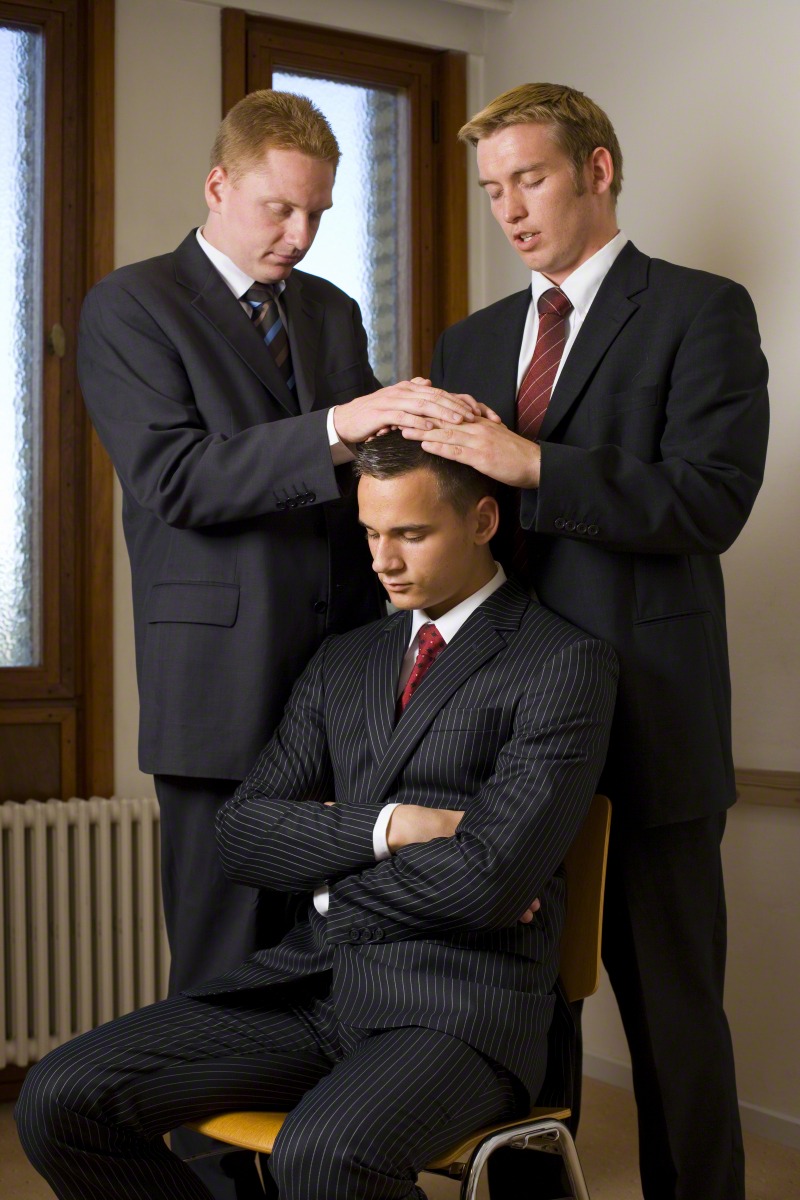 To answer the first question, the authority of God is conferred (or given) by a man who currently has the authority of God to another man (see the picture to the right to see how this is done). To confer or give the priesthood is often called to ordain a man to the priesthood. This priesthood authority is often represented by keys, since keys symbolize a necessary tool to unlock a door in order to continue on to something else that would otherwise be unreachable. Priesthood authority is necessary in order to receive certain blessings from God. This is why the priesthood is so important.
To answer the other two questions, I'll put up a couple more posts about the priesthood in the Mormon church and how it is organized.
What the heck is this blog all about?

Recently, I've sensed a need to understand more about my church, The Church of Jesus Christ of Latter-day Saints. This is why I'm currently enrolled in a religion class at BYU that is focused on the beginnings of my church. I've found it very intriguing and insightful to learn more about the beginnings of my church, and I'm glad that we've discussed a lot of the more hairy topics that get brought up.
For this particular religion class, we've been asked to complete a course project for the semester. Wanting to understand more about my church as I mentioned above, and also wanting to be a bit of a missionary for what I believe, I decided to create this blog. My hope is that I'll not only understand more about my church, but also that I'll help others understand more about my church and want to learn more about it. Specifically for this blog, I plan on helping to understand more about what the priesthood is in the Mormon church.
Subscribe to:
Posts (Atom)